Case 09 · Concept2Design · 2025
- Role
- Product Designer
- Scope
- End-to-end concept
- Type
- Internal AI tool
- Outcome
- Hours → minutes
- Team
- Cross-functional team
↓ Scroll — the work
Doc time cut
from 4–8h to under 10 min
Artifacts generated
PRD · flows · screens · wires
Selective re-runs
no full-pipeline resets
Product teams lose hours, sometimes days, converting rough ideas into PRDs, flows, screen lists, and wireframes. The documentation process is a consistent bottleneck that slows down the path from concept to engineering handoff.
Time Drain
Manual documentation consumes valuable design and product time that could be spent on strategic work.
Inconsistency
Documentation quality varies wildly between team members and projects, creating confusion.
Handoff Friction
Incomplete or delayed documentation creates friction with engineering and slows delivery.
Existing tools are either fully manual (slow but controlled) or opaque AI tools that don't support iteration or trust. There's a gap for something that combines speed with transparency.
"How might we help product teams move from concept to structured design documentation in minutes, without sacrificing trust, control, or clarity?"
Key Constraints
Must support engineering handoff
Outputs need to be actionable for developers
Must allow selective iteration
Regenerate individual artifacts without full re-runs
Must avoid black-box AI behavior
Every decision should be visible and explainable
Must focus on structure, not visuals
Prioritize information architecture over polish
Product Designer
Needs to move fast from concept to structured documentation while maintaining control over quality and iteration.
- Speed without sacrificing quality
- Transparency in AI reasoning
- Control over individual outputs
Product Manager
Needs scope clarity and reliable PRDs that accurately capture requirements for stakeholder alignment.
- Clear scope definition
- Reliable, consistent PRDs
- Confidence in AI outputs
Shared Need
Both personas share a fundamental need for visibility and confidence: knowing what the AI is doing, why it made certain decisions, and having the ability to course-correct when needed.
Reduce documentation time dramatically
From hours or days to minutes, without compromising completeness
Make AI reasoning visible
Every generated artifact should show its sources and logic
Support selective regeneration
Allow users to re-run individual steps without restarting the pipeline
Produce consistent, engineering-ready outputs
Standardized formats that developers can immediately use
Build trust through transparency
Progressive disclosure of AI decisions and confidence levels
Concept2Design structures the documentation process as a transparent, step-by-step pipeline where each phase builds on the previous, and each can be independently controlled.
Normalize Brief
Parse and structure input
Generate PRD
Create requirements doc
Create User Flows
Map user journeys
Build Screen Inventory
Catalog all screens
Generate Wireframes
Create in Figma
Independent Execution
Each step runs independently, allowing targeted regeneration
Full Visibility
All steps are logged and visible in real-time
Selective Re-run
Re-run any step without restarting the entire process
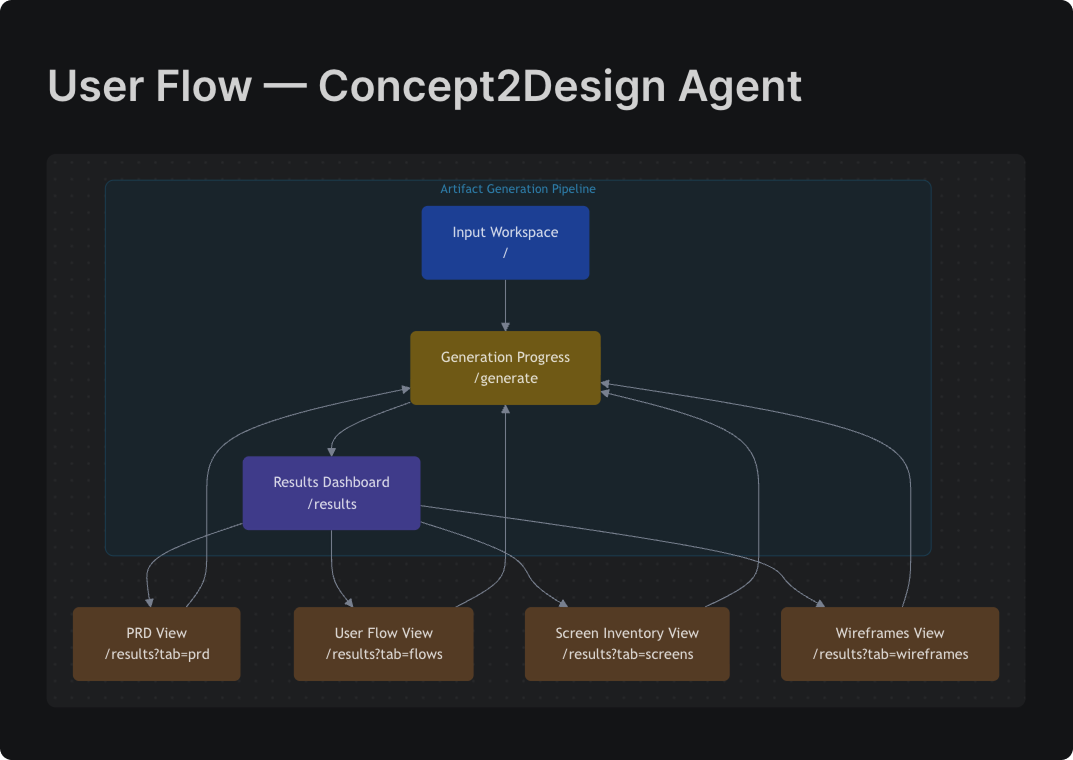
The complete Concept2Design pipeline: from brief input to design artifact generation
Watch how Concept2Design transforms a rough product idea into engineering-ready documentation in just a few steps.
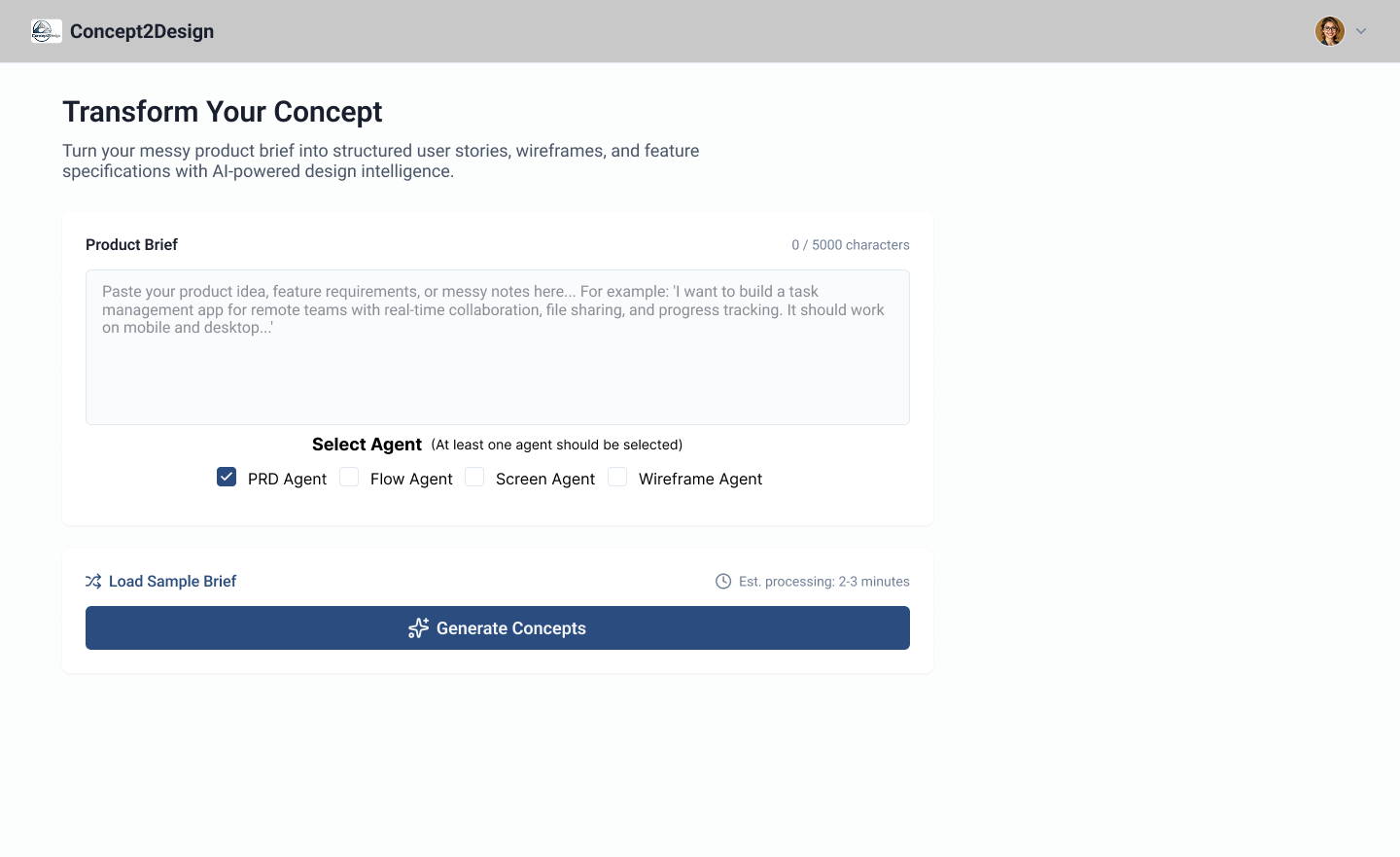
Paste Your Messy Concept
Start with rough ideas, feature lists, or unstructured notes
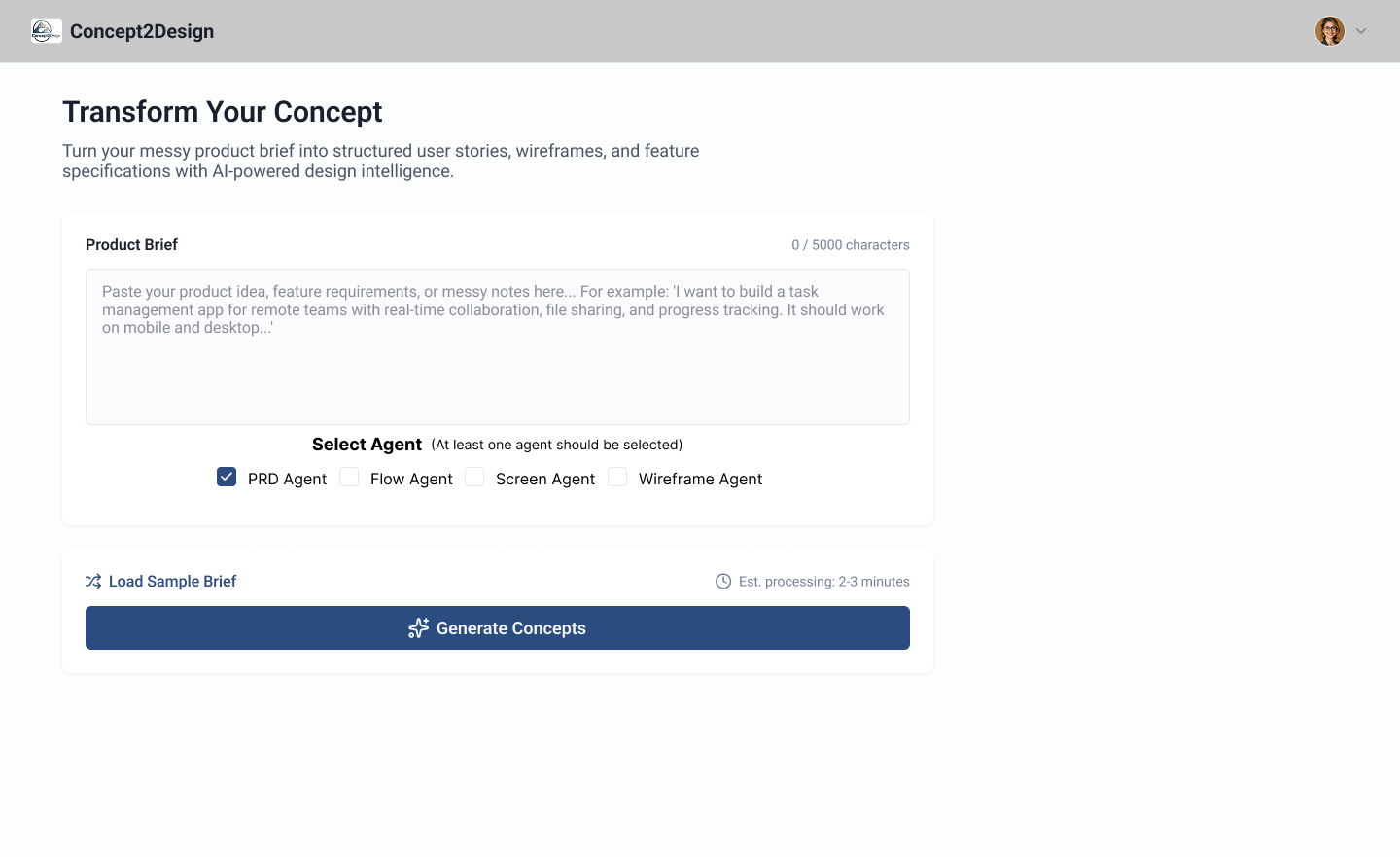
Users paste their product brief, no formatting required. Select which agents to run.
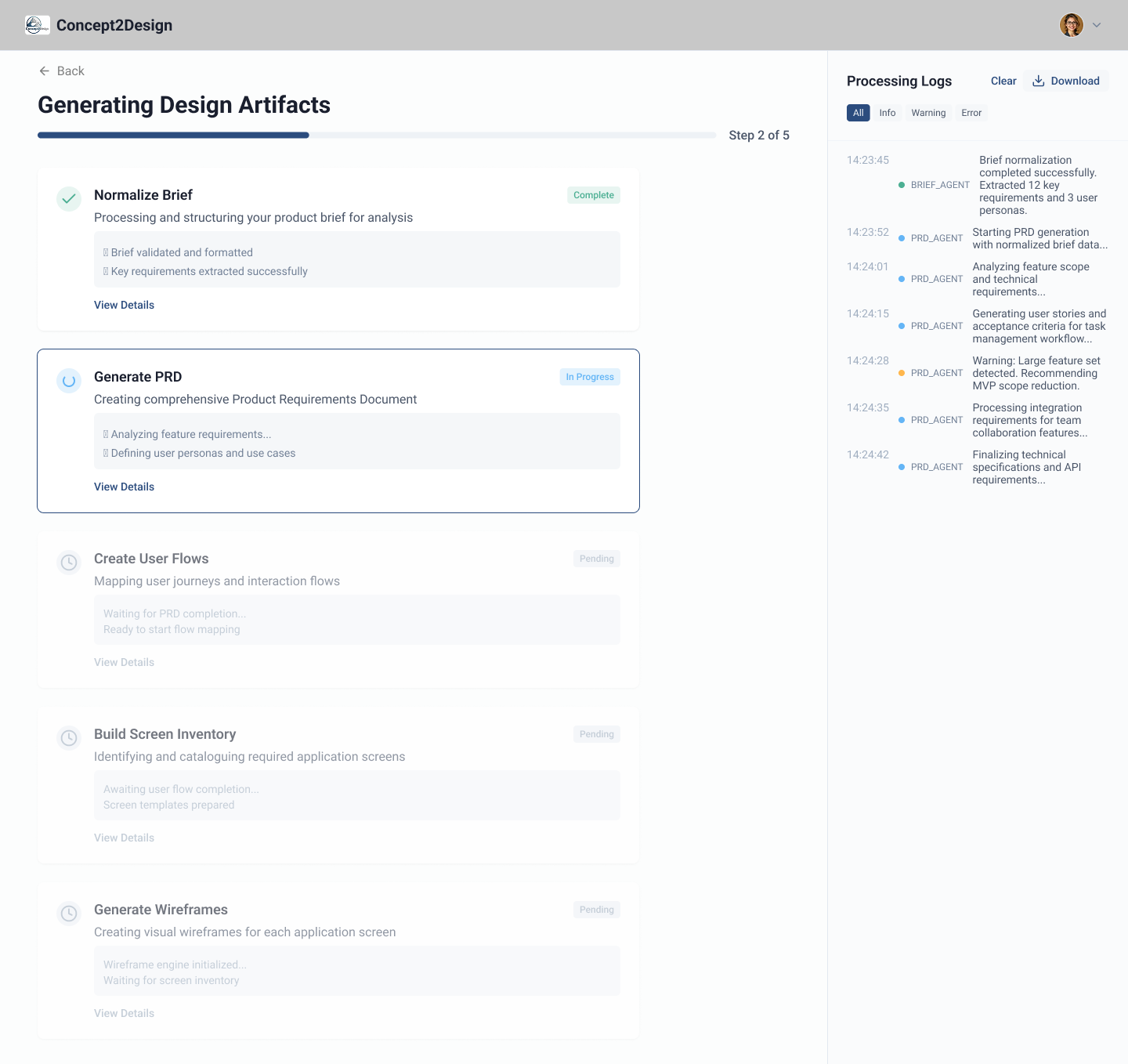
AI Agents Process Your Brief
Watch as specialized agents transform your input step by step
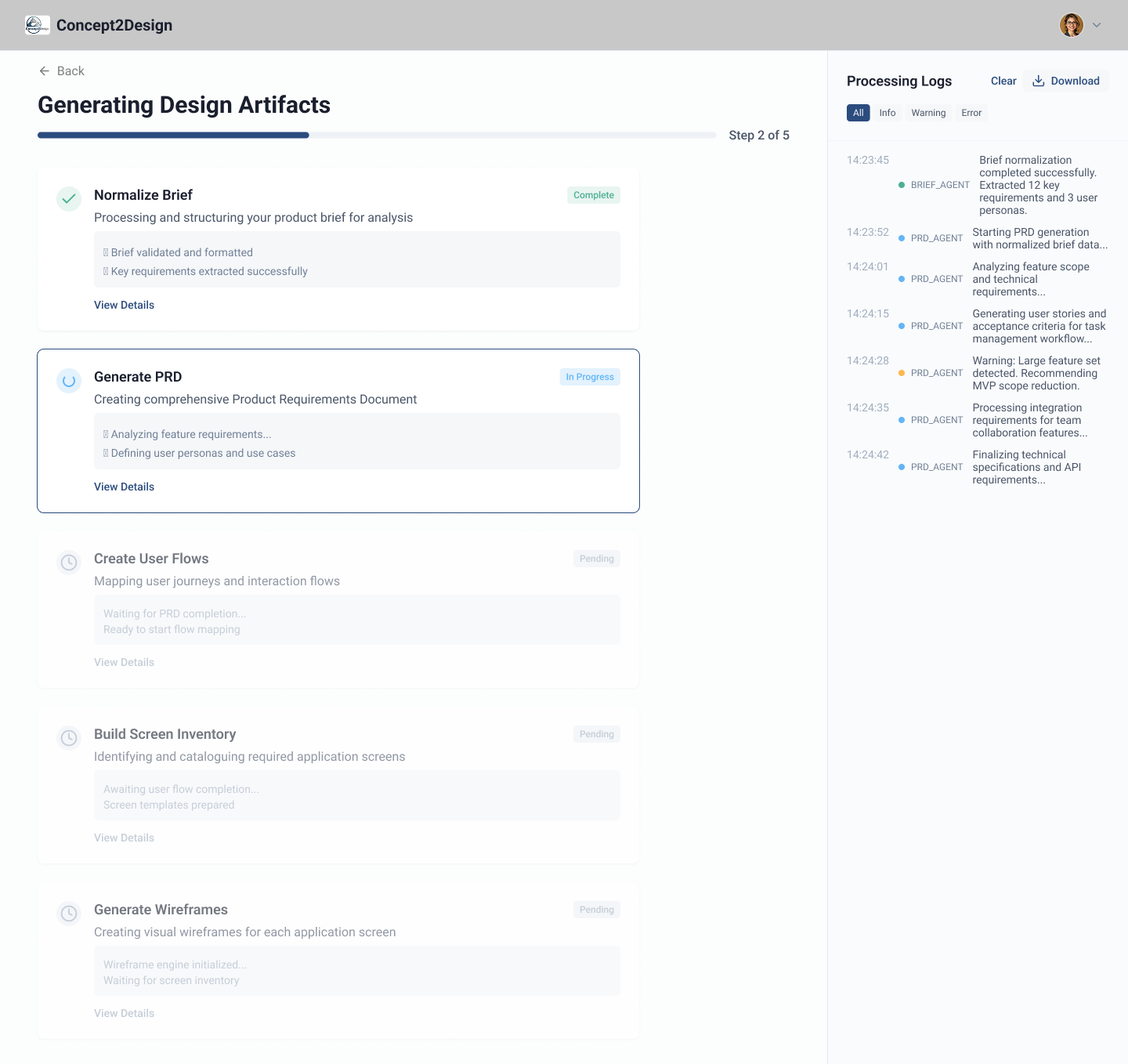
Real-time progress tracking shows exactly what each agent is doing.
Design Insight: The first step normalizes messy input into a structured format, becoming the single source of truth for all downstream generation.
Navigate the Generation Pipeline
Each artifact builds on the previous, creating a coherent documentation set
Clear pipeline view shows dependencies and allows selective regeneration.
Design Insight: Rather than presenting AI as a single "magic" step, the pipeline model makes the transformation process explicit, reducing anxiety and increasing user confidence.
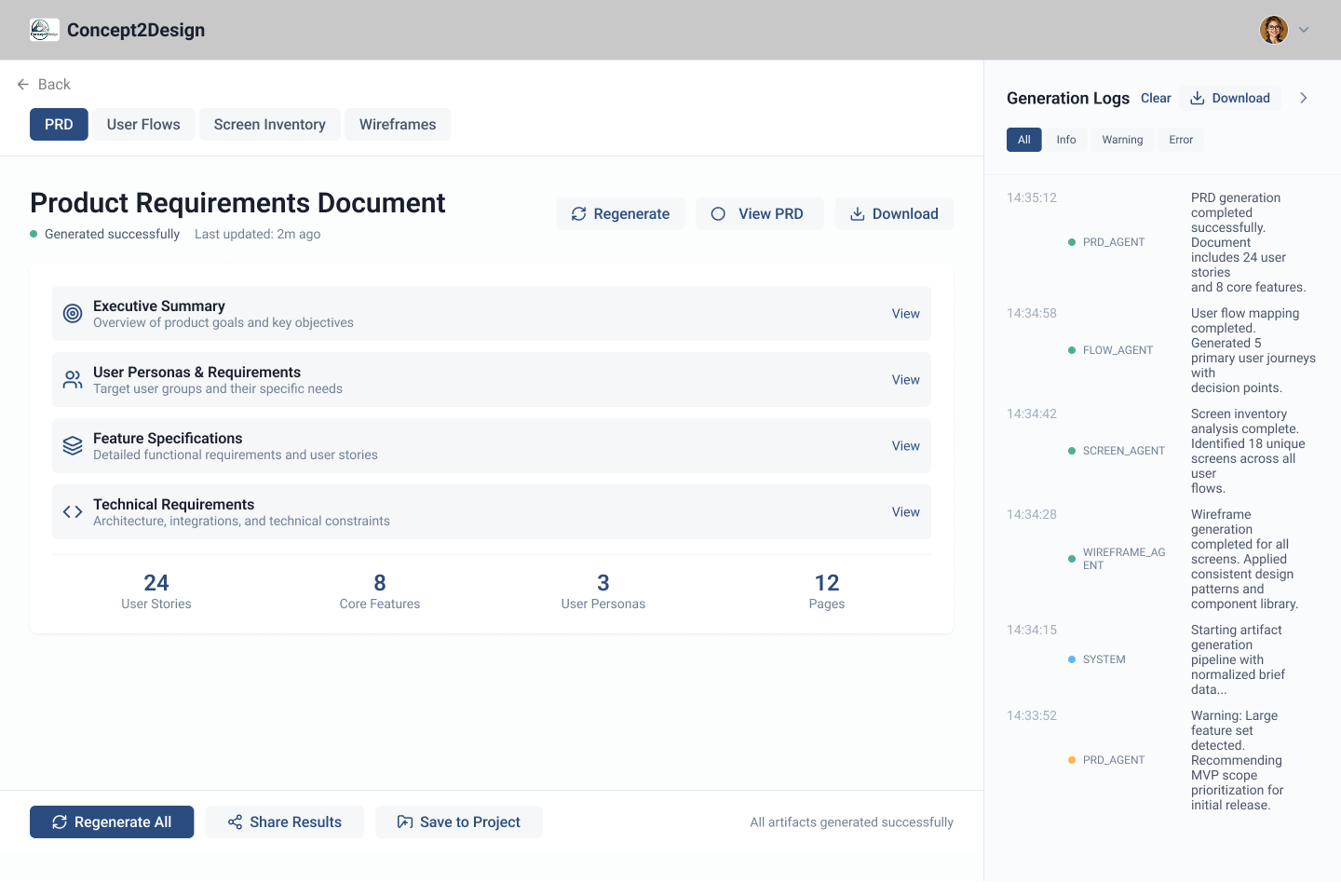
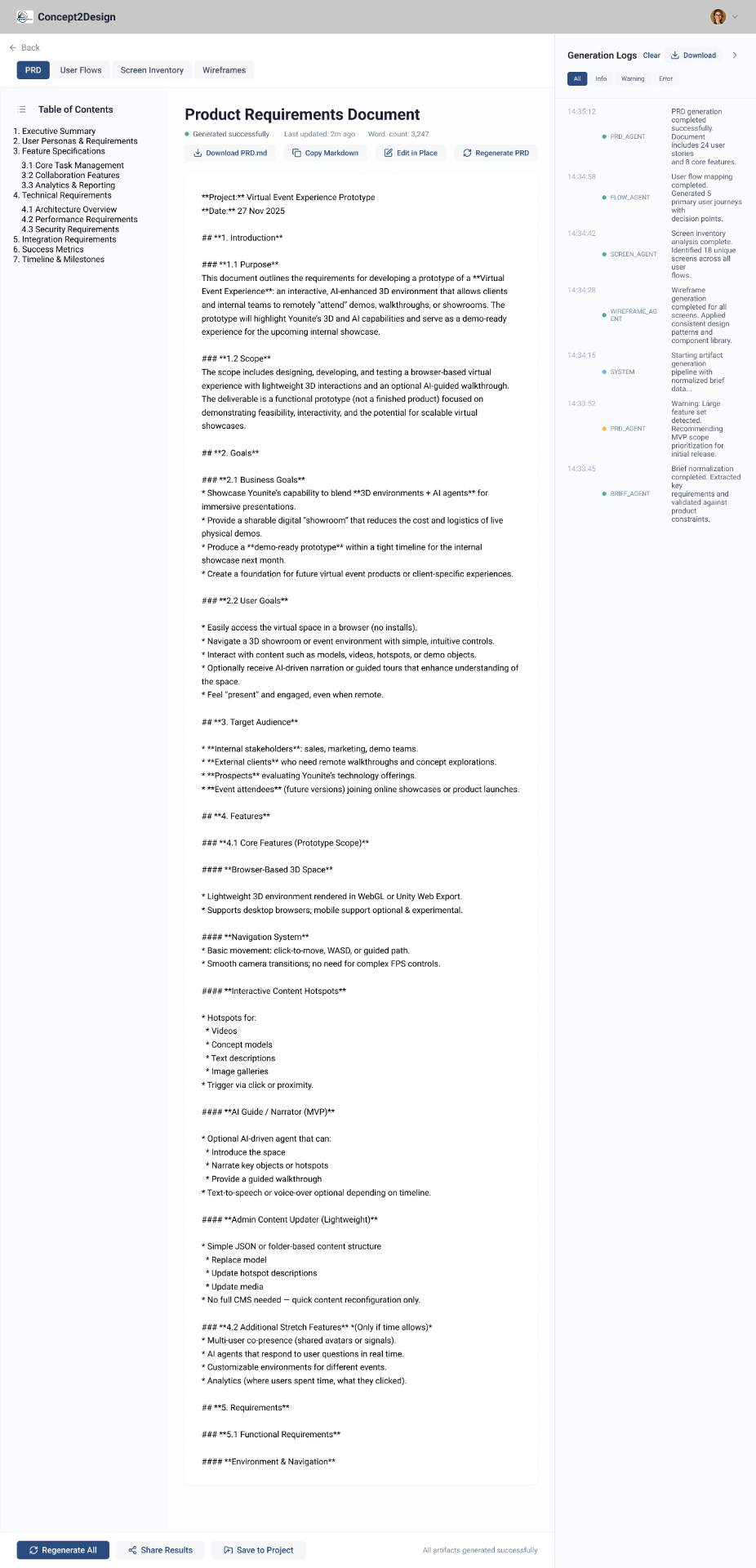
Review Structured Artifacts
Engineering-ready documentation generated in minutes
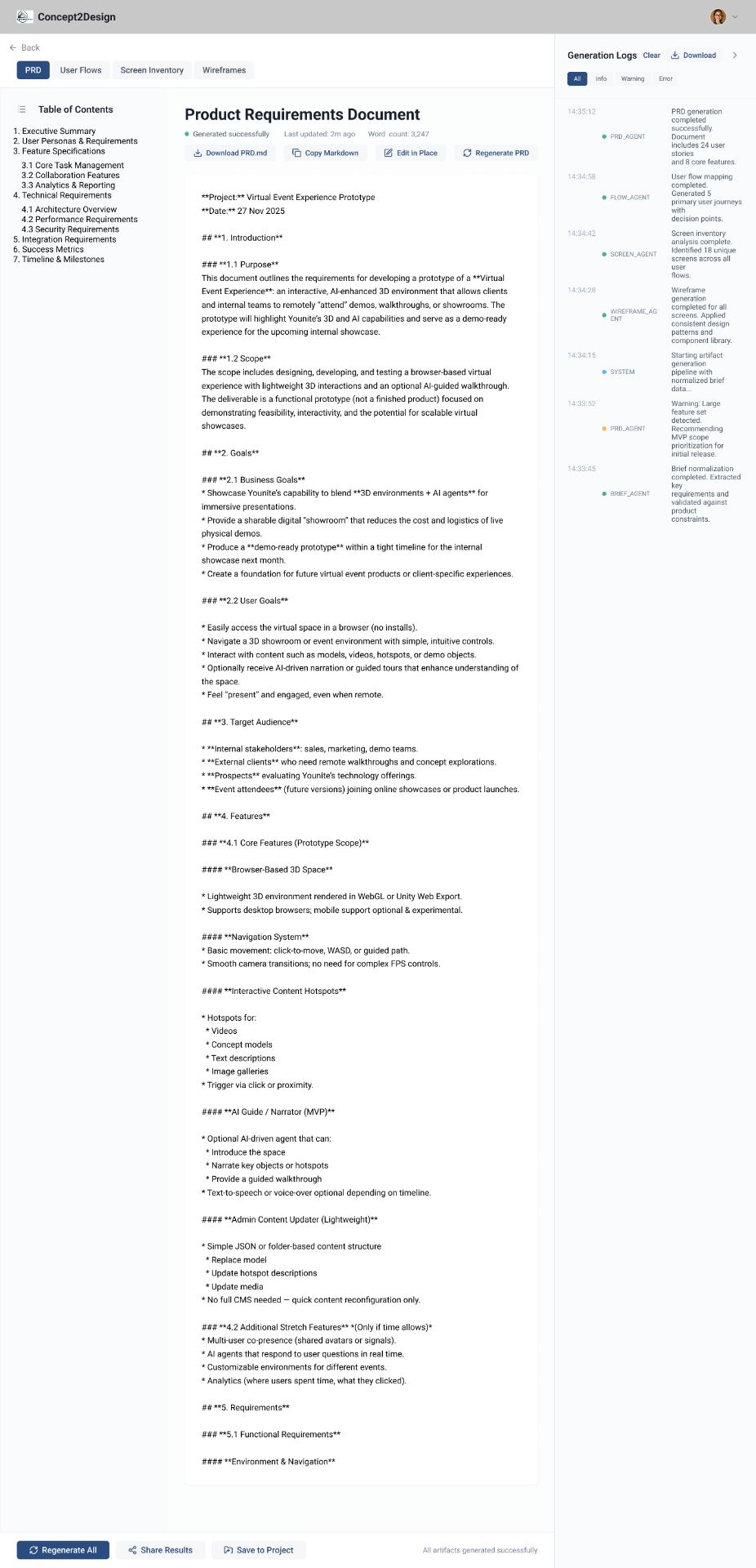
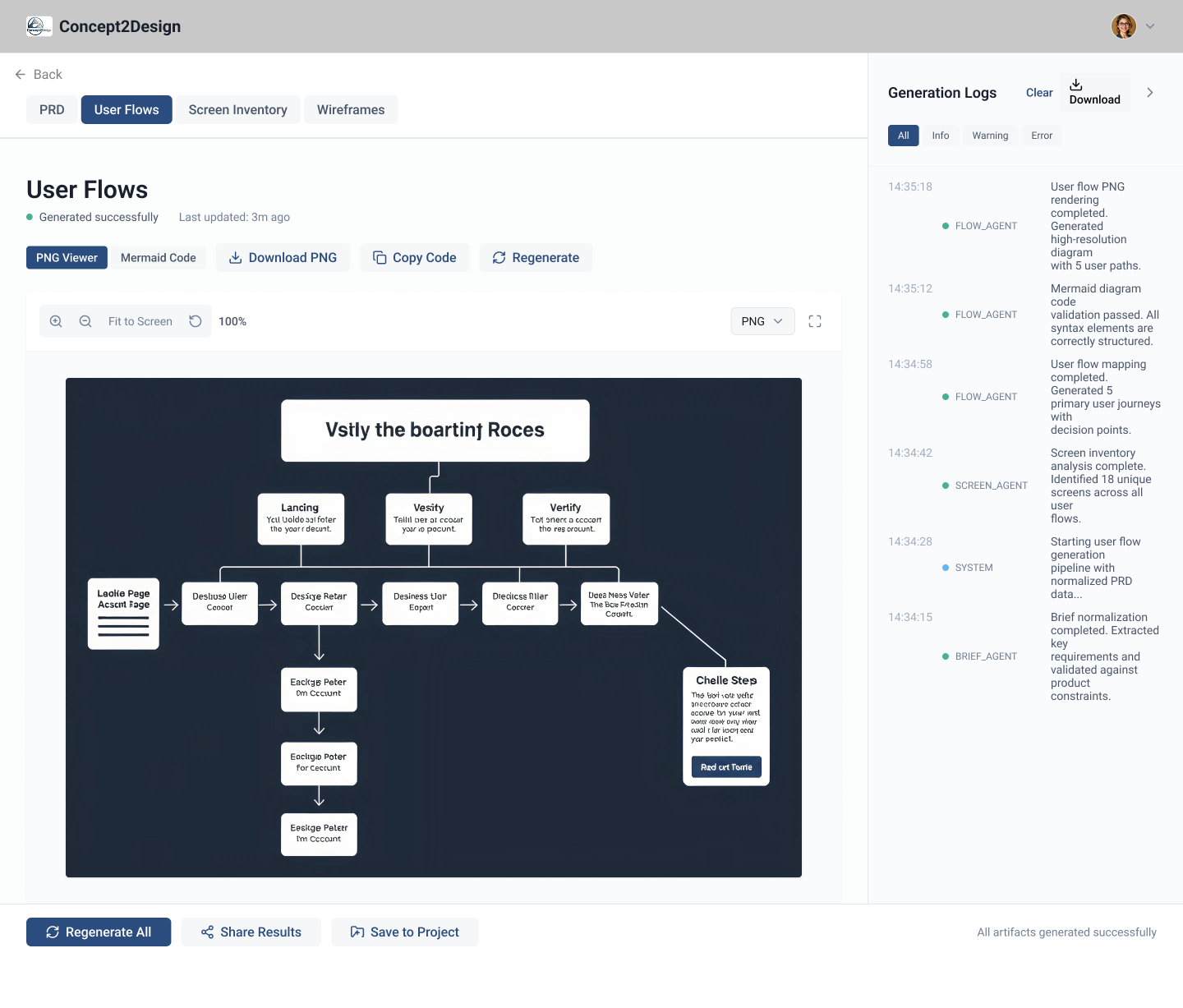
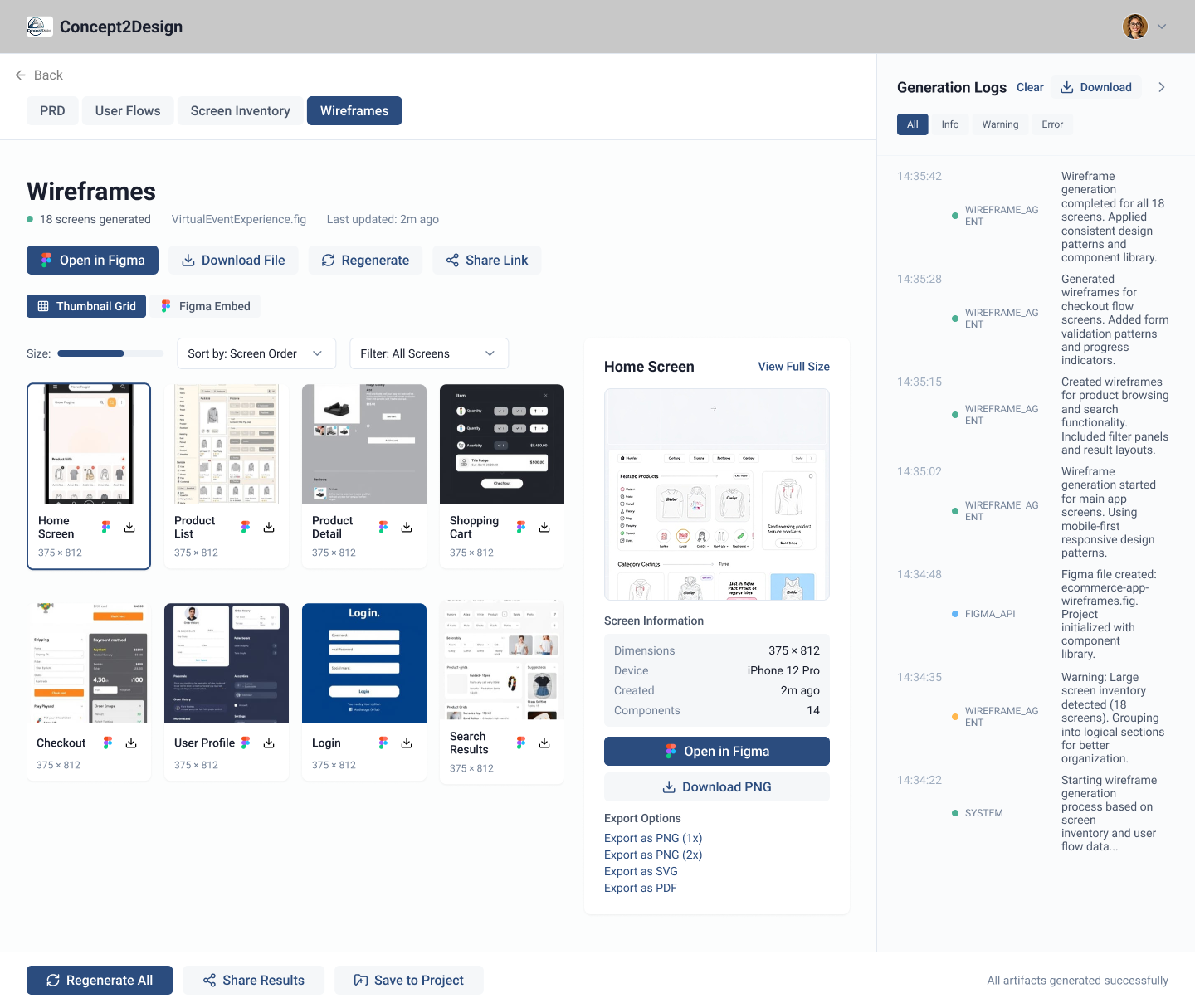
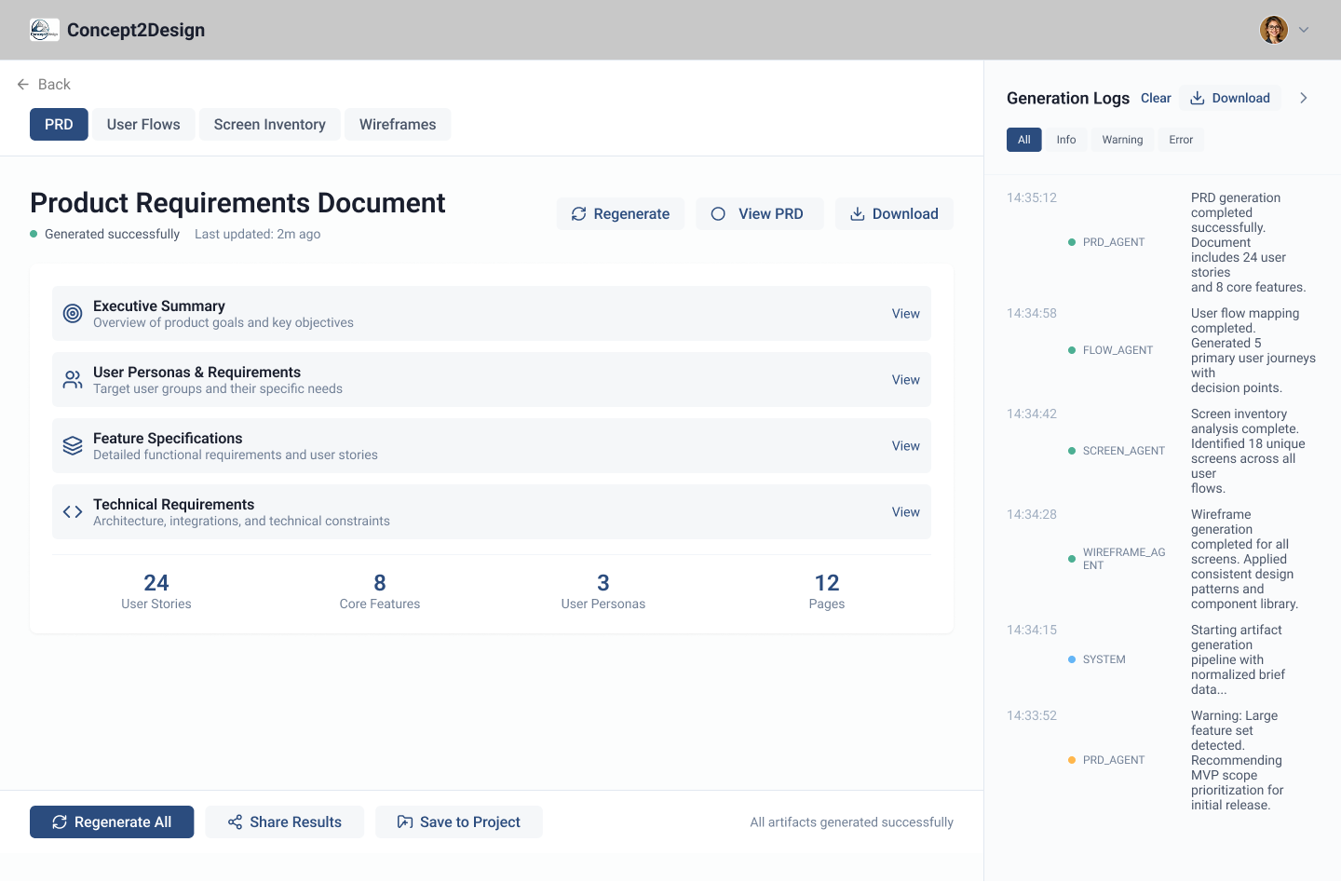
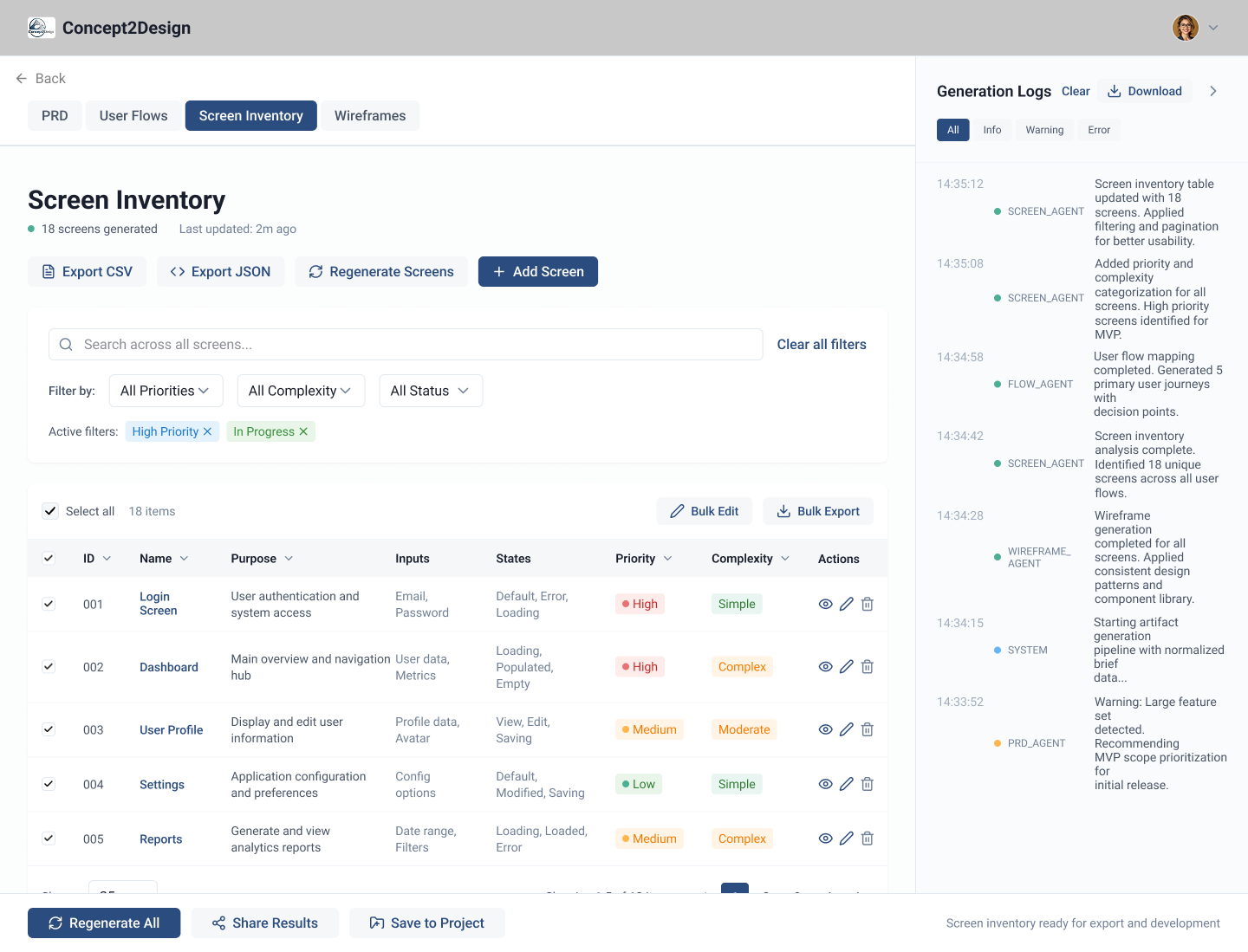
PRDs, user flows, screen inventories, and wireframes: all structured and ready for handoff.
Design Insight: Each artifact type gets its own optimized view. PRDs as documents, flows as visuals, inventories as tables. This respects how different artifacts are actually used.
Selective Regeneration
Refine individual artifacts without reprocessing the entire pipeline
Target specific artifacts for regeneration while preserving the rest of your documentation.
Design Insight: Users can regenerate individual artifacts without affecting others. Changed your mind about user flows? Regenerate just that step. PRD and screen inventory remain intact.
Iterate with Full Control
Complete transparency and control over every output
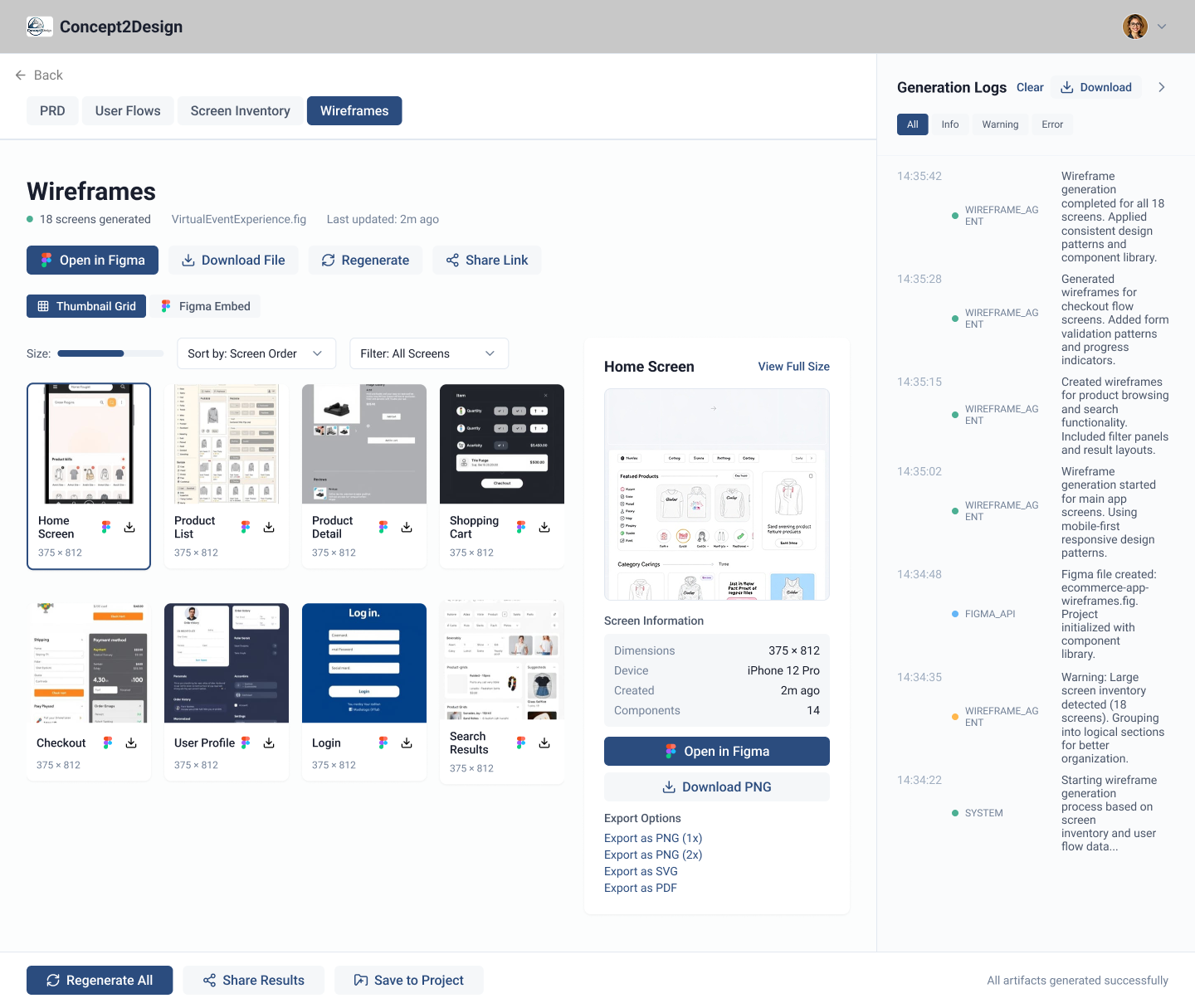
Transparent logs and full control keep you confident in every output.
Design Insight: A real-time log panel shows exactly what the AI is doing, building trust by making the "thinking" visible. Users can trace any output back to its reasoning.
Minutes, Not Hours
What used to take 4-8 hours of manual documentation now completes in under 10 minutes — with consistent quality and engineering-ready outputs every time.
Faster Workflow
Concept-to-handoff time reduced from days to minutes. Initial documentation that previously took 4-8 hours now completes in under 10 minutes.
Consistent Documentation
Standardized output format across all projects. No more variation based on who wrote the docs or how rushed the timeline was.
Higher Confidence
Transparent logging and selective regeneration build trust in AI outputs. Users understand and can verify what they're getting.
Better Collaboration
Shared artifact format improves alignment between design and engineering. Everyone works from the same structured source.
Note: As an internal concept, these outcomes are based on pilot usage and structured estimation rather than large-scale production metrics.
Transparency builds trust in AI tools
Users don't need to understand every algorithm, but they need to see what the AI is doing. Visible logs and explainable steps dramatically reduce skepticism.
Designers need control, not just automation
The goal isn't to replace human judgment — it's to accelerate the mundane parts while preserving creative control. Selective regeneration is key.
Systems thinking matters more than individual screens
Designing a documentation pipeline requires thinking about data flow, dependencies, and failure modes. It's architecture, not just interface.
Progressive disclosure helps manage complexity
Show the essential information first, with details available on demand. The log panel, for example, is collapsible and filterable — power users can dive deep, but it doesn't overwhelm newcomers.
Version history and comparison — track changes between regeneration cycles
Collaboration features — real-time editing and commenting on artifacts
Confidence indicators — show AI certainty levels for inferred content
Stronger validation — error detection and consistency checks for generated flows
Template library — pre-built brief structures for common project types
Export integrations — direct sync with Notion, Linear, and Jira
Concept2Design represents a particular approach to AI-powered tooling: one that prioritizes transparency, control, and structured output over magic-box automation. It's a demonstration of senior product thinking — focusing on workflows and systems rather than individual screens, and treating AI as a tool that augments human judgment rather than replacing it.
The challenge wasn't just "can AI generate a PRD?" — it was "how do we design an AI system that product teams will actually trust and use?" That required thinking about mental models, error recovery, and the relationship between speed and confidence.