Case 01 · Eezy Core · 2023–2025
- Role
- Product Designer
- Timeline
- 2023–2025 · 2 years
- Platform
- Web · Mobile
- Outcome
- 40% operational gain
- Team
- Embedded in product team
↓ Scroll — the work
HR work time freed
from scheduling + reconciliation
Orders automated
end-to-end staffing flow
Data entry reduced
across Customer & Expert
The Constraint
Three apps — Customer, Expert, Talent — three user types with conflicting goals. HR specialists needed fast morning triage; staffing experts needed deep operational control; talent needed simple shift acceptance. AI features had to feel native inside an enterprise system replacing fifteen disconnected tools across Nordic operations.
The Decision
Build a unified design system across all three apps before designing any single surface in detail.
The trade-off was four weeks of upfront foundation work with no visible deliverables. The return was cross-app visual consistency, faster engineering handoffs, and the ability to run parallel design tracks across Customer, Expert, and Talent without drift.
What I'd Do Differently
I'd run the field session with HR specialists in week 1, not week 6. The interview that redirected the entire shift-card hierarchy could have happened earlier and saved a sprint of premature visual design.
Source: eezy.fi · © Eezy Oyj
Research That Changed Direction
The most important research moment wasn't scheduled — it was a field session with Petra, an HR specialist, revealing shift cards were too information-dense for fast morning triage. That single finding redirected the card hierarchy redesign. Mobile task completion time dropped 34% in testing. Research here isn't a project phase — it's the continuous signal that shapes what gets built next.
The Design System Decision
Early in the project I agreed to invest in a unified design system spanning Customer, Expert, and Talent apps before designing any surface in detail. The tradeoff was upfront time. The return was cross-app visual consistency, faster engineering handoffs, and the ability to run parallel design work across three surfaces without drift.
The Loops That Moved Numbers
Post-launch analytics showed 38% drop-off at step 3 of the HR setup wizard. I prototyped three progressive disclosure variations and tested with 5 HR operators before rebuilding. Drop-off fell from 38% to 11% within 6 weeks. Prototyping here wasn't about polish — it was about catching expensive mistakes before engineering built them.
The Push-Back That Paid Off
The hardest collaboration moment was pushing for a sticky contextual action bar for batch approvals — initially deprioritised by engineering as scope creep. Pre-launch feedback showed HR managers losing 2–3 seconds per batch scrolling to find the action. Post-launch: batch approval time reduced 3× for queues of 5+ shifts. Zero support tickets about it afterwards.
Simplification Over Features
The biggest workflow win wasn't adding a feature — it was the 'Smart Repeat' pattern that surfaced recurring shift patterns from order history and pre-filled new orders. HR specialists were rebuilding identical orders manually every time. Automation rate went from 18% to 25%, hitting the target set at project kick-off. Operational efficiency here meant removing decisions, not adding tools.
With a workforce spanning multiple generations and technical literacy levels, WCAG 2.1 AA compliance was a baseline requirement. All interactive elements meet a minimum 4.5:1 contrast ratio, the HR dashboard is fully keyboard-navigable, and dynamic content — including live shift status updates and notification feeds — is marked up with screen-reader-compatible ARIA labels.
Delivered a comprehensive end-to-end service experience across three primary user groups: Customer, Expert, and Talent.
Implemented AI-powered job and worker matching, reducing response times from hours to mere minutes.
Enabled faster onboarding, request creation flow, and improved usability through tailored interfaces on both mobile and web platforms, achieving a 40% reduction in data entry time.
Utilised a unified design system, enhancing collaboration and consistency between design and development teams.
Significantly accelerated staffing turnaround times.
Eliminated 50% of manual HR workload through automation and streamlined workflows.
Automated over 25% of ad hoc staffing orders, improving speed and accuracy.
Achieved notable gains in profitability and operational efficiency.
Developed streamlined data pipelines to support more responsive service delivery.
Laid the foundation for scalable, modular service components supporting future growth.
Signal
Post-launch dashboards showed 38% drop-off at step 3 of the HR setup wizard — users were abandoning before finishing onboarding.
What Changed
Redesigned the wizard with progressive disclosure: collapsed optional fields behind an "Advanced" toggle, surfaced only the 4 required fields on first run.
Outcome
Onboarding drop-off fell from 38% to 11% within 6 weeks of the update.
Signal
Order automation KPI plateaued at 18% — well short of the 25% target. Analytics showed recurring order patterns existed but were not being surfaced.
What Changed
Designed a "Smart Repeat" feature that detected recurring shift patterns from history and pre-filled new orders. Ran usability tests with 5 HR specialists to validate the match-quality threshold.
Outcome
Automation rate reached 25% in Q2 2024, matching the target set at project kick-off.
Signal
Pilot sessions with Petra (HR specialist) revealed shift cards on mobile were too information-dense for fast decision-making during busy staffing windows.
What Changed
Restructured the card hierarchy: role, date, and status in the top 44px; secondary details collapsed behind a chevron. Validated new layout with a 5-second scan test.
Outcome
Task completion time on mobile dropped 34%. Petra reported she could triage morning shifts "in the same time it used to take just to scroll".
Signal
Pre-launch feedback from HR managers showed they were scrolling to find the bulk-approve action during peak hours — causing a 2–3 second delay per batch.
What Changed
Added a sticky contextual action bar that appeared when 2+ items were selected, anchored above the list with approve, reject, and assign shortcuts.
Outcome
Batch approval time reduced 3× for queues of 5+ shifts. Zero support requests about the action being "hard to find" after release.
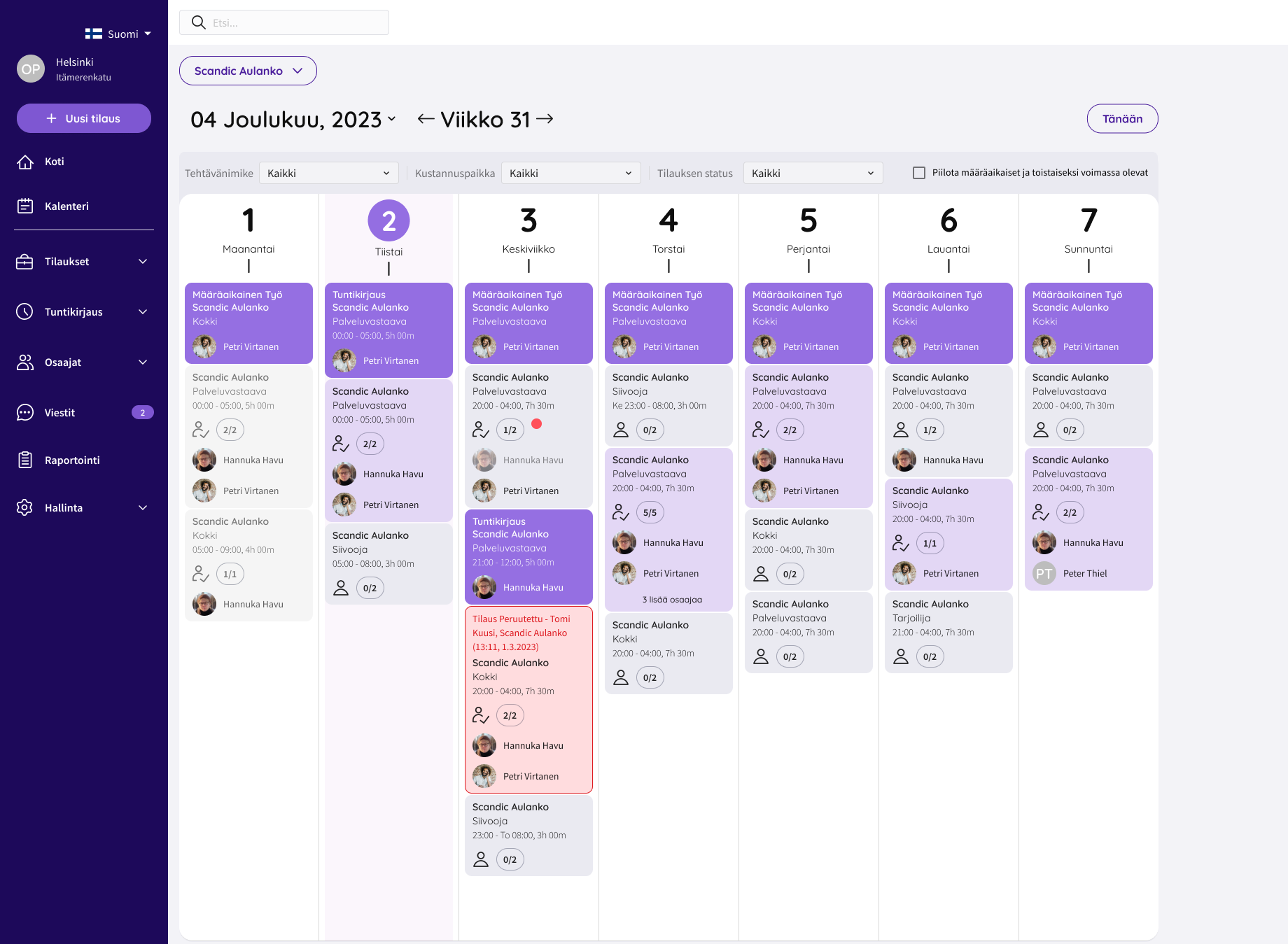
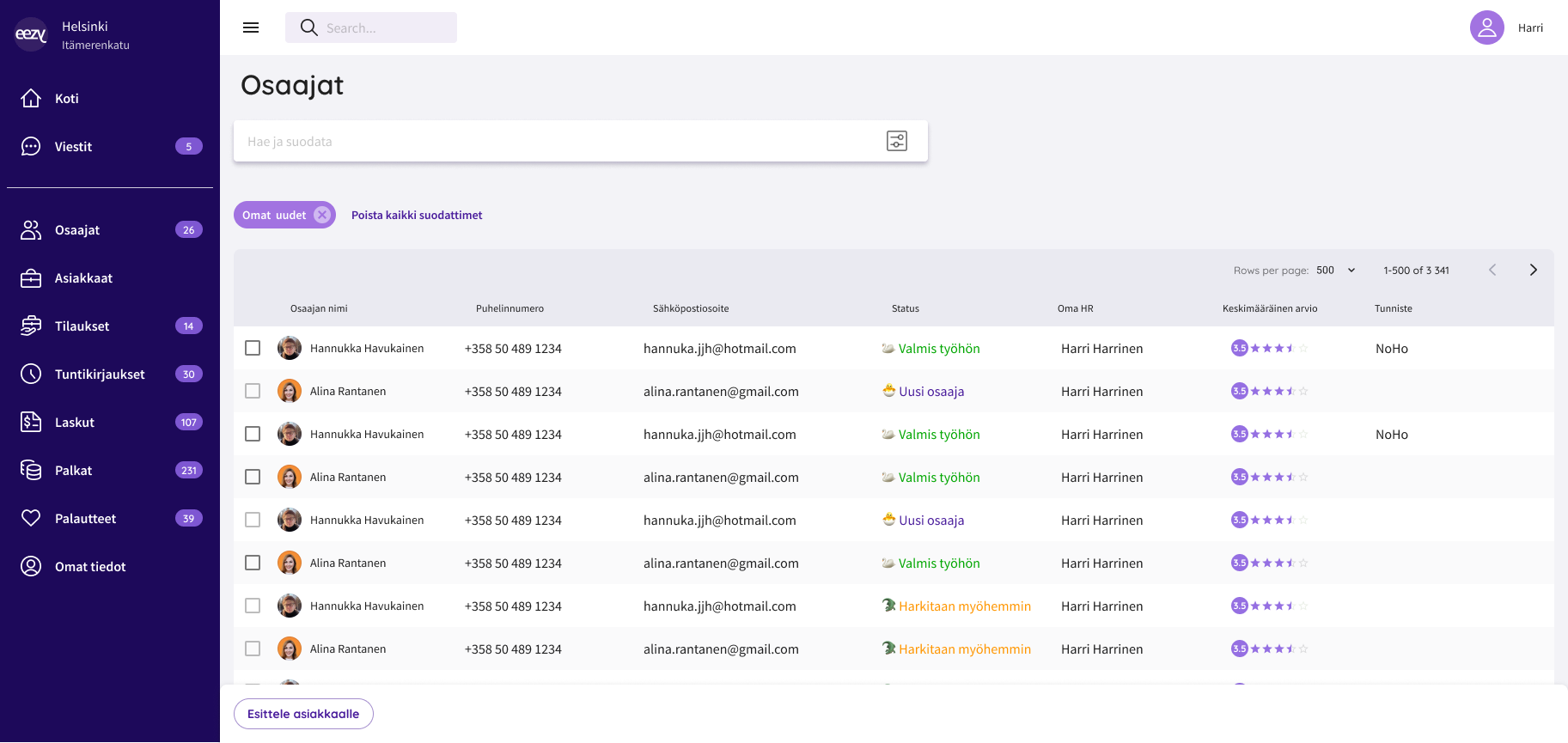
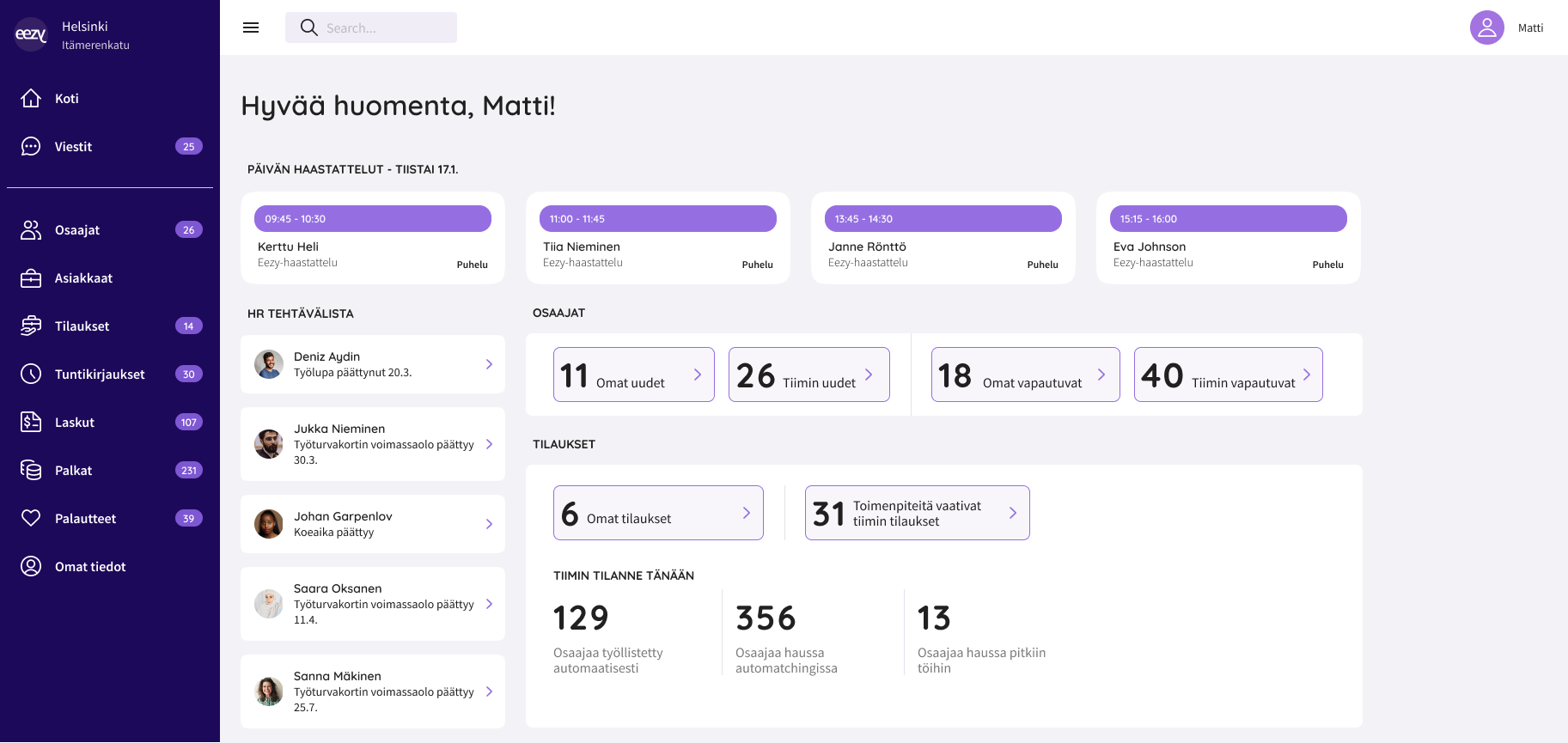
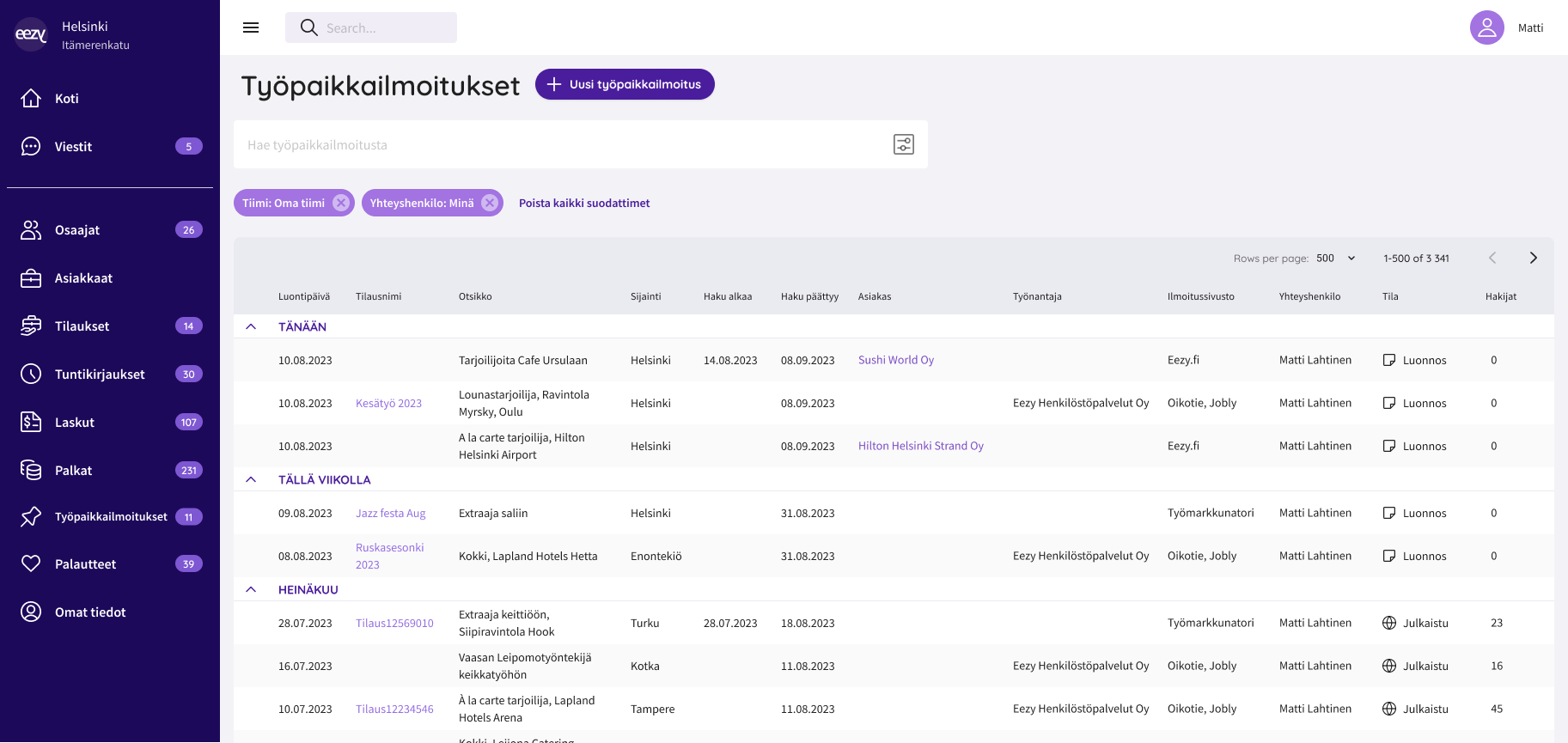
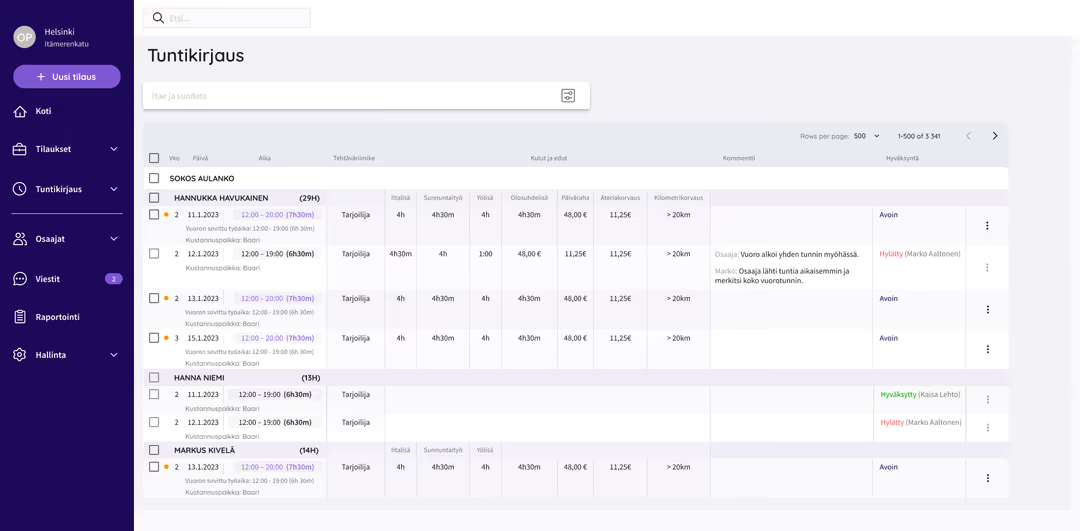
The platform features a comprehensive suite of interfaces designed for different user roles — from HR specialists managing daily operations to talent accessing their schedules and communicating with coordinators.
Expert Dashboard - Daily Overview
Comprehensive dashboard showing daily interviews, staff metrics, and HR analytics
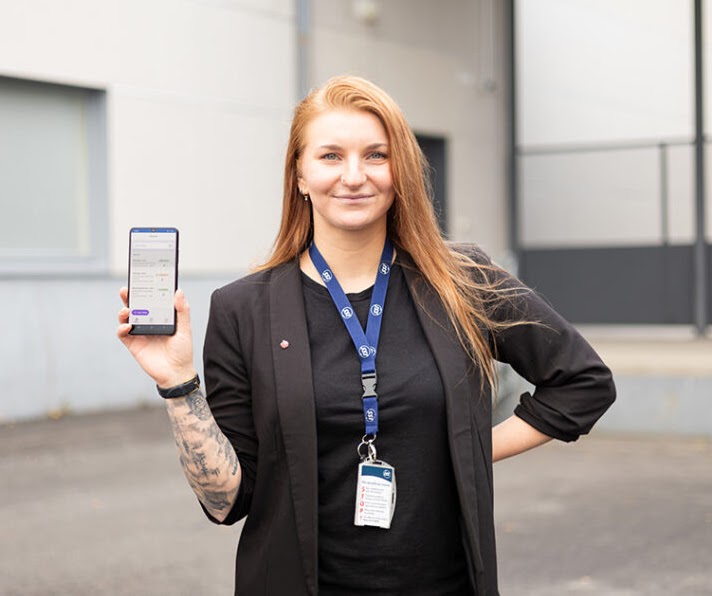
Petra Saarela, ISS's Assistant Restaurant Manager, is one of the pilot users of the Eezy Customers app. Source and copyright: https://eezy.fi/eezy-sovellukset-eezy-asiakkaat/
The best thing about the app is its ease of use
"One advantage of the application is that I can see the shifts that have been made for us previously and the information about them. It makes it easier to find the right person. Especially in the evenings, it is great that you can open a shift yourself."
"Apps are often filled with things when different needs are discovered, but we have been positively surprised by how simplified the Eezy app is. It has been stripped of unnecessary things and has kept everything essential."
Finding replacements is one of Saarela's tasks. Depending on the time of year, especially during flu season, it can take up to a couple of hours a day. He has been piloting the new app since April 2024.
Booking employees has never been easier
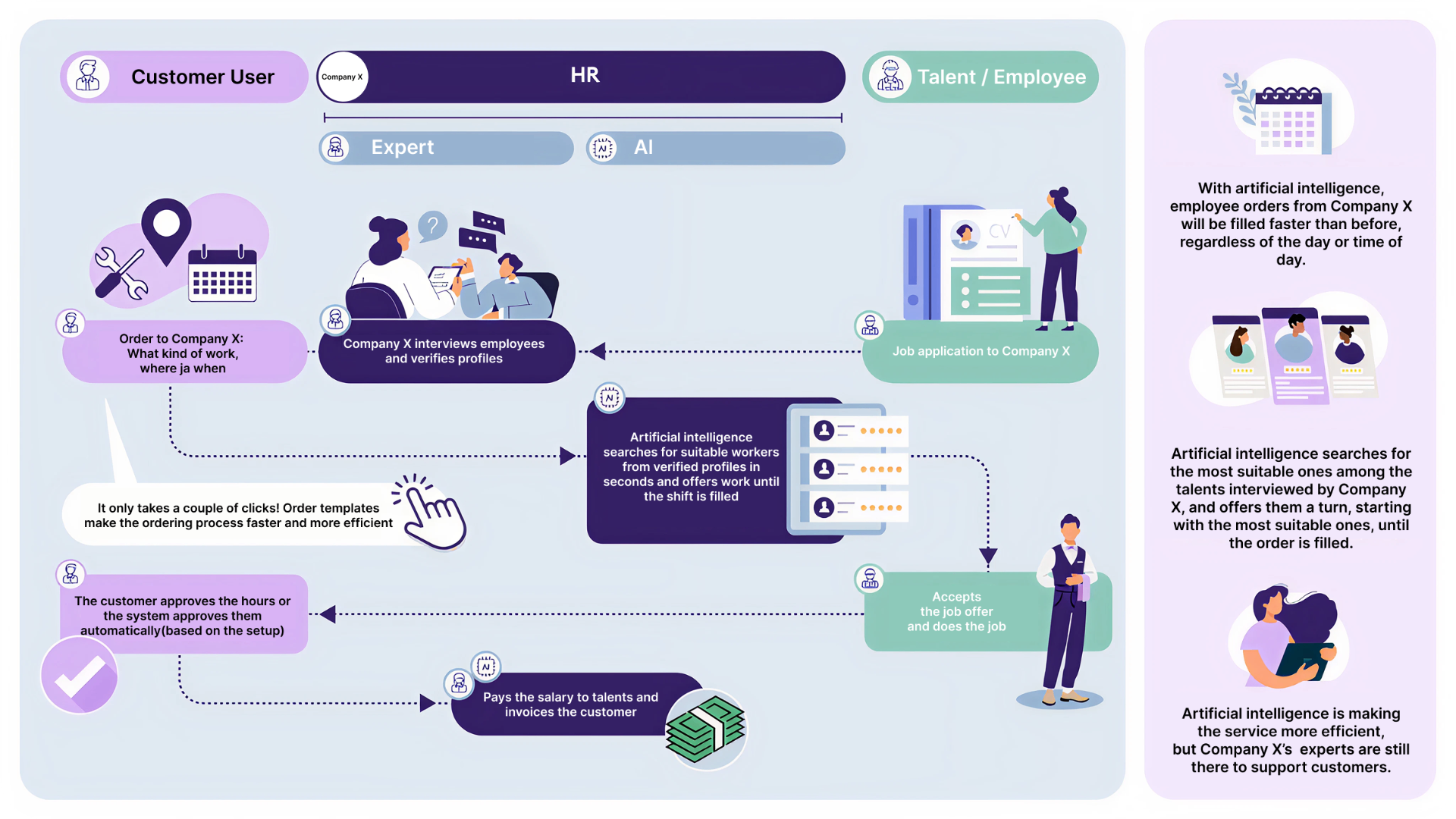
Historic moments are being experienced at Eezy, and with it at customers' desks. A completely redesigned and digitalized workflow and related applications will be available for the first time in November 2024. The system speeds up ordering and filling shifts, reduces memory-intensive shredding work, and helps you focus on what's important - people.
"It is typical that applications are created for customer or employee interfaces. Our idea is to digitalize the entire business process. We wanted to start thinking about how traditionally manual work could be done digitally and thus take our business forward."
— Päivi Salo, Digital Director at Eezy
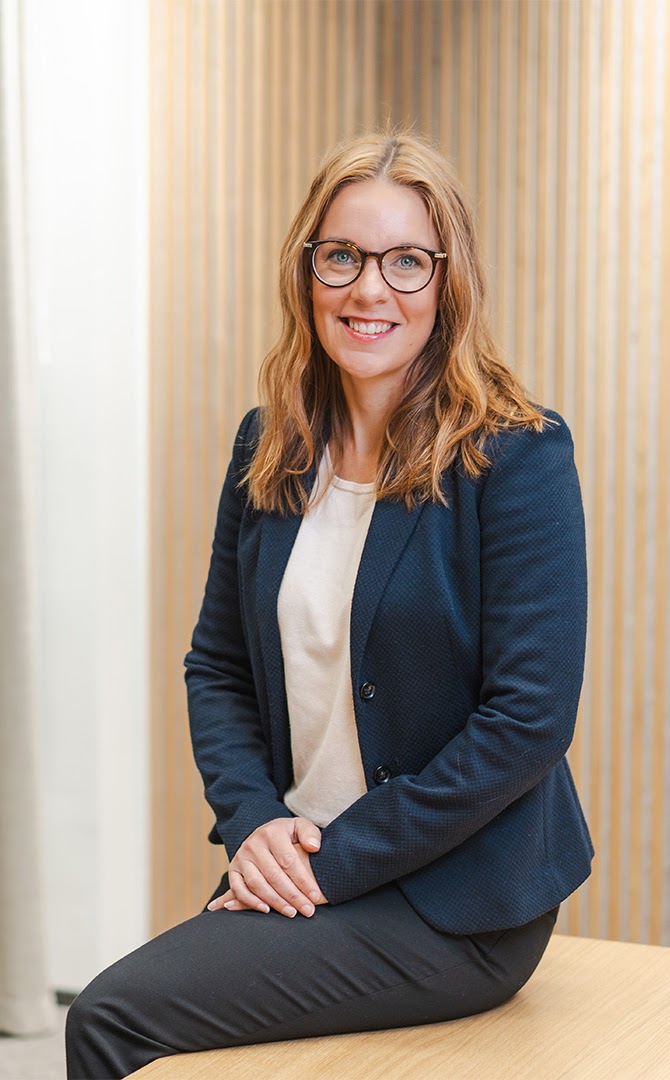
Päivi Salo, Digital Director at Eezy. Source and copyright: https://eezy.fi/eezy-sovellukset-eezy-asiakkaat/