Case 12 · Inclusive Cycling · 2022
- Role
- Service Designer
- Scope
- Service design
- Framework
- Double Diamond
- Outcome
- Cycling game concept
- Team
- Academic project
↓ Scroll — the work
Parents interviewed
from the target city area
Root-cause insights
motivation, not skill or bike access
Service concept
game-layer for daily rides
01 — Overview
As a service designer on this project, the role was to help the municipality achieve smart mobility and tackle the challenge of transporting children to kindergarten in a sustainable and inclusive manner. The project targets families with 5–6 year old children, focusing on the real motivational and behavioural barriers preventing daily cycling — rather than assumed barriers like skill or bike availability.
"Promote cycling among families with young kids and achieve smart, clean, and inclusive mobility options for the city."
🎯 Project Objectives
Promote sustainable transportation over less eco-friendly options
Encourage families with young kids to choose cycling for kindergarten transport
Educate kids on traffic regulations, independence, and cycling safety
Motivate kids and parents to incorporate physical activity into daily routines
Foster a culture of environmentally conscious and cooperative traffic behaviour
Explore new ways to ensure safe transport for kids, including in winter months
02 — Design Process
Double Diamond Framework
The project followed the four phases of the Double Diamond — Discover, Define, Develop, Deliver — to move from broad research to a focused, validated concept.
Discover
Divergent
Broad research to understand the problem space
Define
Convergent
Synthesise findings and focus on root causes
Develop
Divergent
Generate and filter solution ideas
Deliver
Convergent
Prototype, test, and finalise the concept
03 — Research Methods
8 Methods Across the Process
Discover
Stakeholder Map
Identified all individuals affected by or able to influence the service and grouped them by level of involvement.
Discover
Secondary Research
Explored existing published data on children's cycling safety, skills, and travel behaviour; defined research questions via Google Scholar.
Discover
User Interviews
Interviewed parents of 5–6 year old children to gather understanding of context, opinions, experiences, needs, pains, and gains; 8 parents from the targeted city.
Discover
Personas
Created four reliable and realistic representations of key user segments to make design assumptions explicit.
Discover
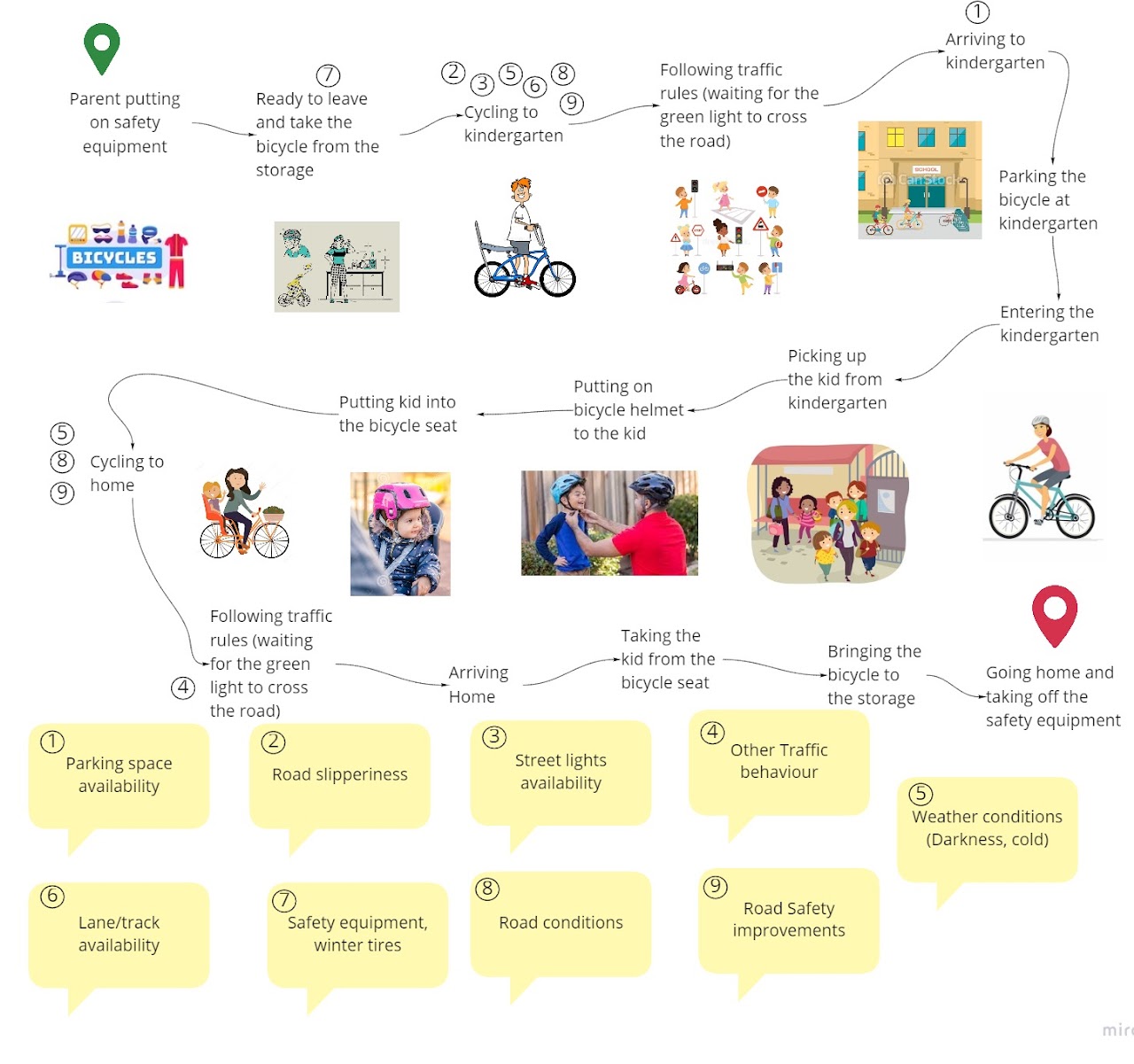
Customer Journey Map
Visualised typical parent and child journeys in two scenarios to identify pain points, emotions, and opportunities.
Discover & Deliver
Service Blueprint
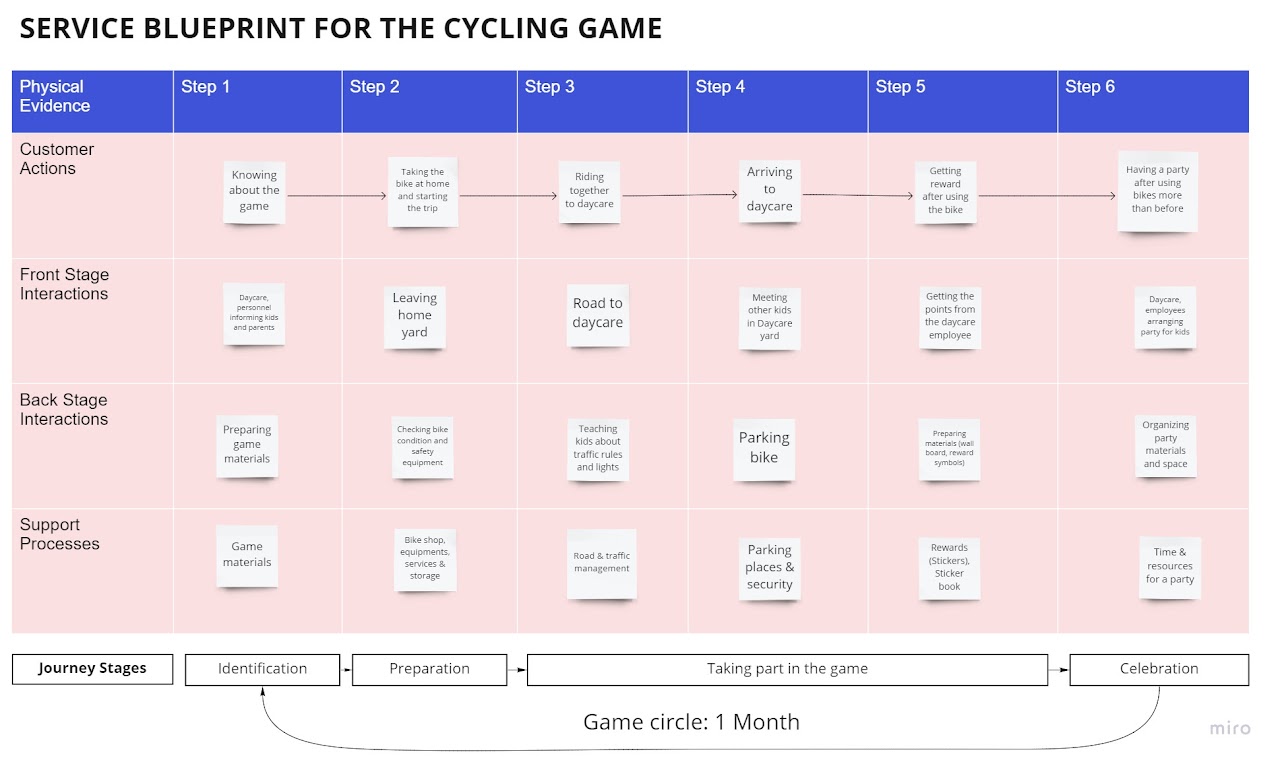
Full end-to-end blueprint showing customer actions, supporting stakeholders, backstage processes, and line of visibility.
Develop
Brainstorming
Group sessions to quickly generate ideas for solving cycling issues and increasing bicycle use for kindergarten transportation.
Develop
Affinity Mapping
Sorted and clustered solution ideas into meaningful groups to surface the most promising directions.
Deliver
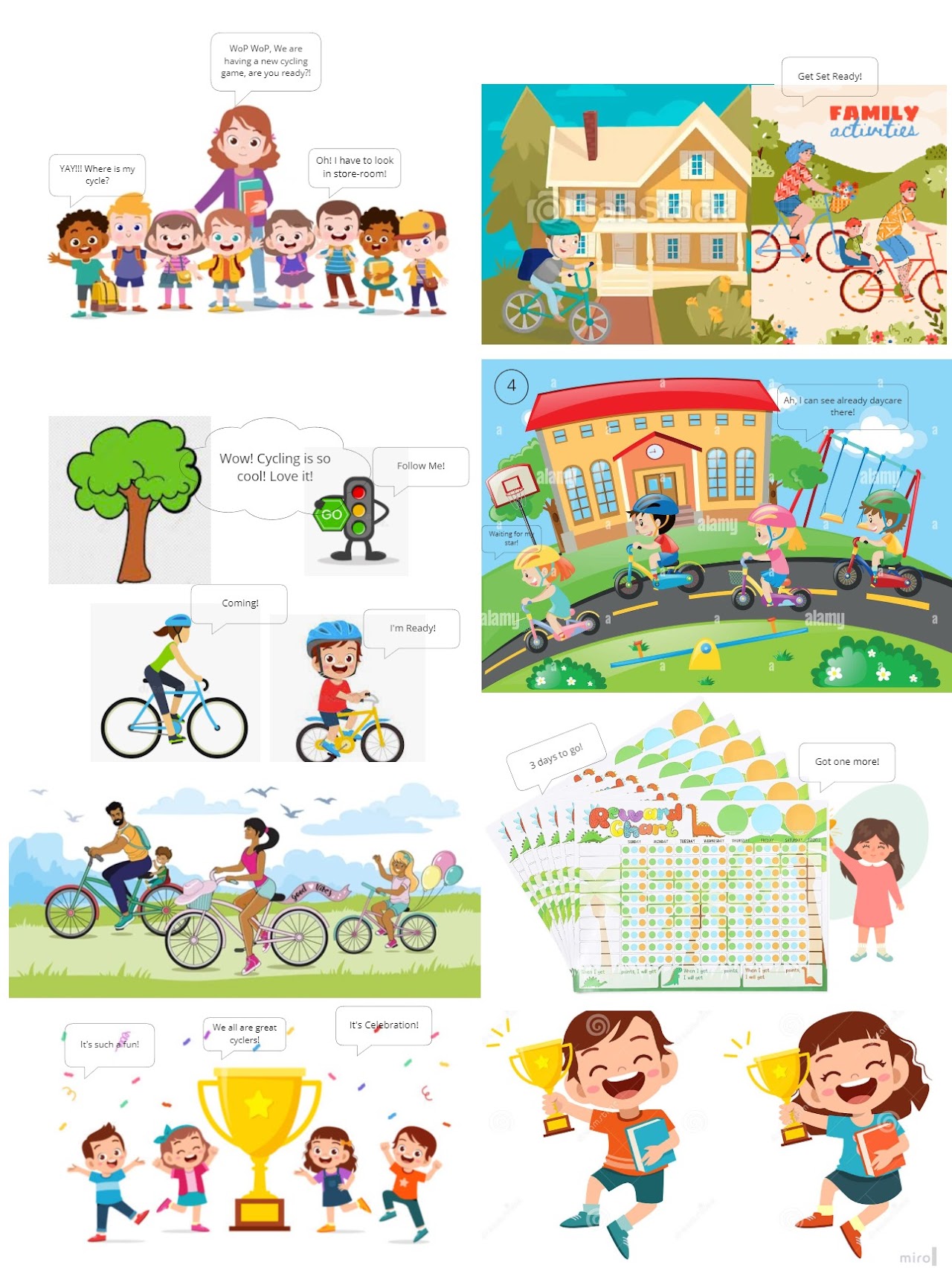
Storyboards
Illustrated sequences of events to visualise and prototype the Cycling Game concept; quick to produce and test.
Discover & Deliver
Business Model Canvas
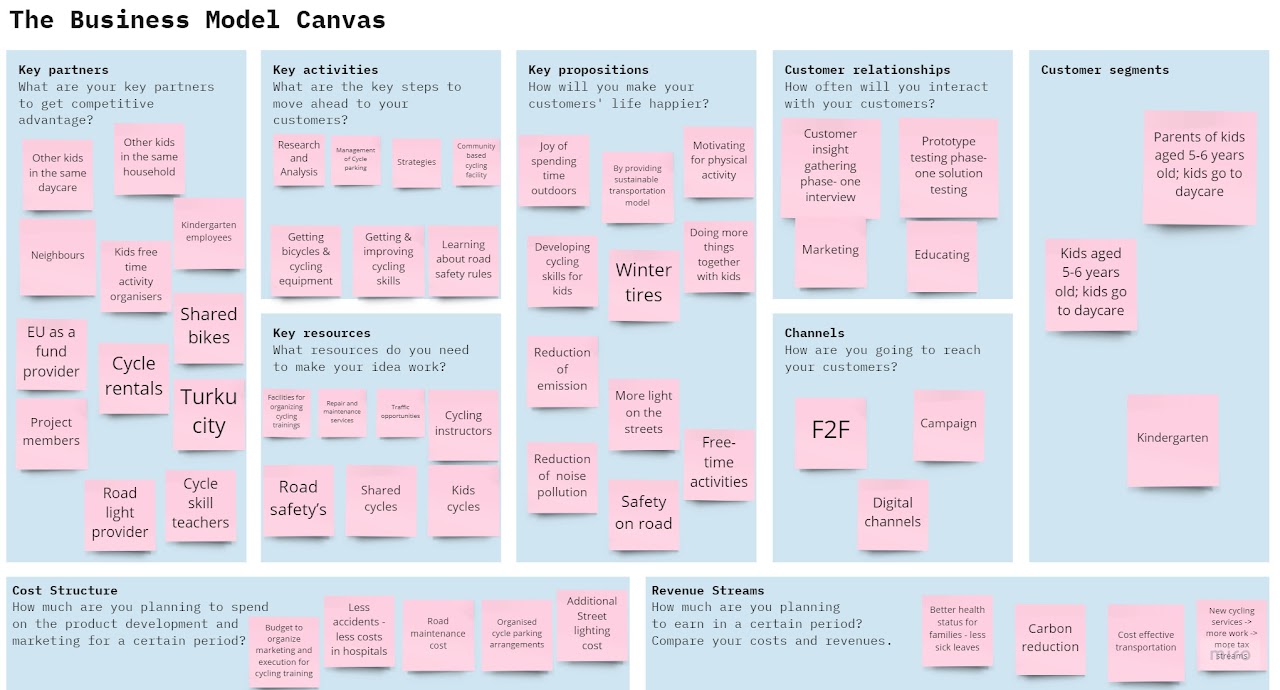
Used to validate whether the concept creates value for all stakeholder groups and identify key partnerships needed.
04 — Key Research Insights
What I Actually Found
The research phase revealed important insights — and demolished several early assumptions. The real barriers were not what I expected.
Skills and bike access aren't the barrier
In all interviewed families, 5–6 year old children already owned a bike and already had cycling skills. Cycling courses or shared bicycle schemes would likely have little impact.
Weather reduces cycling but isn't the root cause
Bad weather was cited as a barrier. Better lighting and improved cycle roads could help. City should consider LED upgrades, anti-slippery tools, and bike lamps for children.
Distance to daycare is too far for many families
Optimal cycling distance for 5–6 year olds is 500m–1km (max 2km). Recommendation: city should review daycare allocation regulations to factor in cycling distance.
Motivation and community are the missing ingredients
Parents value time predictability — cycling with small kids is unpredictable. Key levers: child's own motivation, daily habits, community feeling at daycare.
05 — Design Work Artifacts
Research & Design Deliverables
Seven structured artifacts produced across the Double Diamond process.
Four personas representing key user groups — working parents, active families, cautious parents, and the cycling child — created from qualitative interview data.
The Busy Working Parent
PRIMARY PERSONA
"I want to cycle with my child but mornings are so unpredictable — I just can't risk being late for work."
The Active Family Parent
SECONDARY PERSONA
"We love cycling as a family but the daycare is just too far for my 5-year-old to manage every day."
The Safety-Conscious Parent
SECONDARY PERSONA
"I would cycle with her but I'm worried about the road — there are no proper cycle paths near our home."
The Curious Child
CHILD PERSONA (age 5–6)
"I want to cycle to school like the big kids! Can we go tomorrow?"
06 — Solution Concept
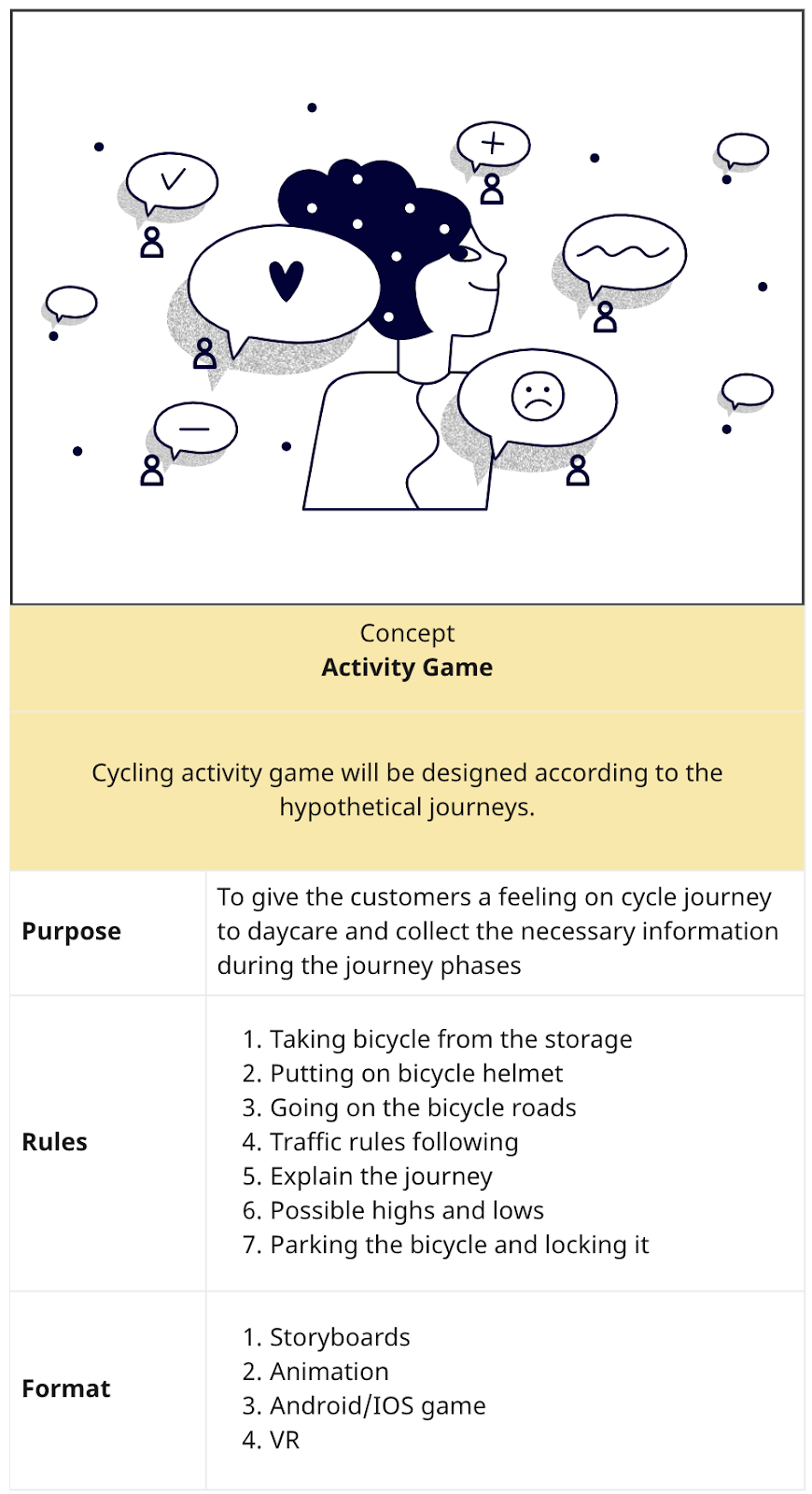
The Win-Win Cycling Game
After ideation and testing, I selected the Cycling Game as the activation concept. The concept is built on the core insight that the key levers are children's intrinsic motivation and community feeling — not skills, equipment, or infrastructure alone.
Group-based challenge system
Children placed in small teams. Each day they cycle, the team earns points. Weekly group rewards build collective motivation.
Visual tracking board at daycare
A physical game board at the daycare entrance makes progress visible to children, parents, and staff daily.
City-level data for planning
Cycling data from the game is shared with the municipality, supporting evidence-based cycling infrastructure investment.
Low-resource, high-impact
Requires minimal city investment — primarily daycare staff engagement — making it scalable across multiple centres.
Win-Win Cycling Game
Gamified daily cycling tracker that builds community at daycare and motivates children intrinsically.
07 — Reflection
What I Learned
Start from root causes, not symptoms — the most valuable insight was discovering what was NOT the barrier.
Narrowing focus accelerates progress — a tighter focus on 5–6 year olds helped me move faster and produce more relevant insights.
Double Diamond works naturally — I found the four phases intuitive; the structured rhythm prevented premature solutioning.
User age complexity — a key challenge was deciding whose behavioural change to prioritise: parents and children have fundamentally different motivations.
Geographic distance limited interview reach — despite being outside the targeted city, I interviewed 8 parents from the target area.
Community feeling is an underrated design lever — the concept that resonated most with both children and parents was social, not statistical.
Commissioner's Targets
The project uncovered key factors of motivation and demotivation for cycling related to daily transportation to kindergarten. By starting from root causes — elaborating motivation and community — the city can reach sustainable increases in cycling and acceptance of sustainable transport.